Architecting Influence
Mastering the Art of Technical Pre-Sales
His badge was turned around, so I couldn't tell where he was from.
He asked what we did. I asked what he did instead. Twenty minutes later I knew his bank’s authentication platform was preventing his digital team from innovating, and three months after that we signed the contract — no RFP, no proof of concept.
I've spent thirty years in tech pre-sales. This is the book I wish someone had handed me in February 1990.
Your technical knowledge is the price of admission. It gets you in the room. But it's not what keeps you there.
Who I wrote it for
If you're a solutions engineer, a pre-sales architect, a solutions consultant, a technical account manager or a developer advocate, this is for you. So is it if you manage a team of them, or if you're sitting in engineering, DevRel or professional services wondering what the move across would actually be like.
You're good at what you do. You know your technology inside out. But you've noticed that the people in your company with the most influence and the most interesting work are the ones sitting between the technology and the customer — and from the outside that looks like a gift you were either born with or you weren't.
It isn't. It's a set of skills. They can be learned, practised and mastered like any language or methodology you've picked up already, and this book is my attempt to write them down in the order that makes them learnable.
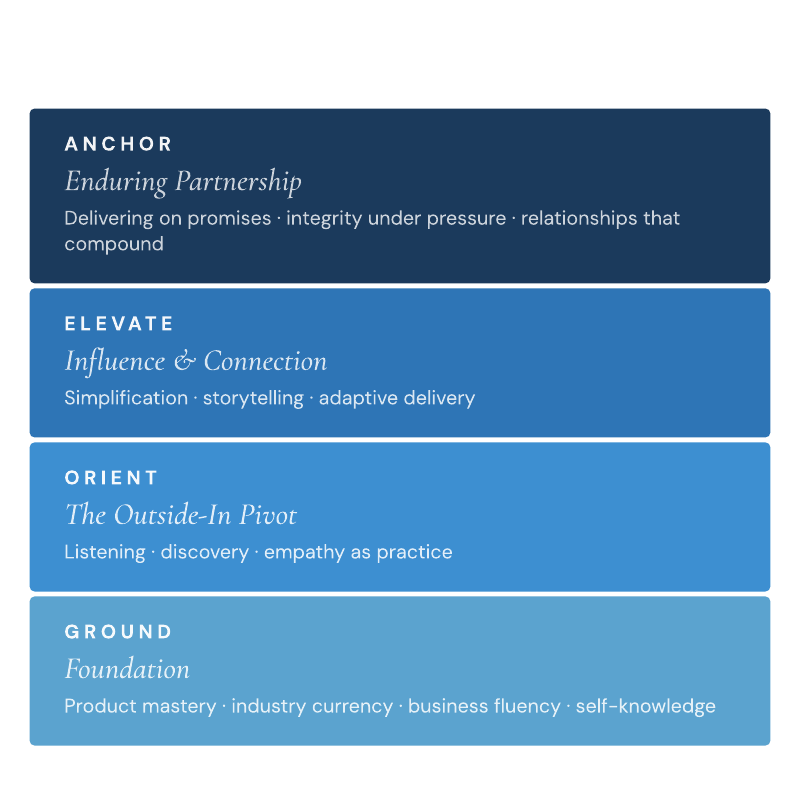
The framework has four stages, and you can't skip one.
The Influence Architecture is the model I've been building for thirty years — a way to think about the skills that turn a technical expert into the person customers ring before they've finished writing their requirements.
Each stage sits on the one below it, like the floors of a building. Skip one and the structure is unstable. Build all four and you get something that lasts longer than any job you hold.
It works at two scales. Across the arc of a career, and inside a single meeting: a ten-minute conversation at a trade show runs through all four stages the same way a year-long enterprise campaign does.
Every chapter starts with something
that actually happened to me.
Sometimes a win. More often a failure I'd rather not have on paper. Then it gets practical: how to explain what your product does in thirty seconds without jargon, the Carrot and Stick framework for talking about business outcomes, the seven questions I ask in discovery, how to map stakeholders by influence and favourability, the five principles of demo delivery, and what to do when the demo breaks in front of forty people.
Part I — Foundations
Ch. 1 — The Trusted Advisor
Ch. 2 — The Influence Architecture
Part II — Ground
Ch. 3 — Know Your Product
Ch. 4 — Know Your Industry
Ch. 5 — Know Yourself
Part III — Orient
Ch. 6 — The Art of Listening
Ch. 7 — Discovery
Ch. 8 — Reading the Room
Part IV — Elevate
Ch. 9 — Simplification & Storytelling
Ch. 10 — Presentations & Performance
Ch. 11 — Demonstrations
Ch. 12 — Written Communication
Part V — Anchor
Ch. 13 — Delivering on Promises
Ch. 14 — Working with Your Team
Ch. 15 — Customers, Partners & Competitors
Ch. 16 — Public Speaking & Events
Part VI — The Long Game
Ch. 17 — Building Your Career
Quick Reference Card
Three questions I ask
every SE I mentor.
If any of those made you pause, you're the reason I wrote this. Every chapter ends with a handful more like them.
A worksheet from the book
Print it, fill it in, and keep it next to the deal. Stakeholder map: who has influence in the deal, and how they feel about you. From Chapter 8.
Three questions
- Can you explain your product's value in thirty seconds without using jargon?
- Do you know the names and the motivations of every stakeholder in your current deal?
- When did you last change your presentation halfway through, because of something you saw in the room?
About me
I've spent over three decades in IT, most of it in digital identity and cybersecurity. IBM, Netscape, Sun Microsystems, Oracle, Ping Identity, Biza.io — as an application support engineer, a pre-sales engineer, a consulting architect and a regional chief technology officer. I still build demos and write POC code, and work hands-on with OIDC, OAuth and SAML.
I speak at industry events around the world, and I'm a founding member of IDPro, the professional body for identity management. Almost everything in this book I learned the slow way: mentorship, watching people who were better at it than me, practice, and a decent number of spectacular failures.
I live in Melbourne. When I'm not helping customers solve problems I'm usually noodling with a vintage synthesiser, or working on my next novel.

Chapter 1 is here, in full.
It's about the trusted advisor: the trade show, the bank, and the sales rep at IBM who told me to stop talking about Unix. Read it and decide for yourself whether the rest is worth your time.
The book ships in February 2027. If you'd like to know when it does, leave your email.
If you want this for your team
I run half-day and full-day workshops built around the four stages, in person or remote, and I give keynotes at conferences and sales kickoffs. Bulk copies for a team are straightforward to arrange once the book is out.
Email me at contact@architectinginfluence.com and tell me what you're trying to improve.
You don't have to become an extrovert to excel in pre-sales. You have to become yourself — and learn to bring that into the room.